Elderly Care Massage — a Niche Few Train For
Older clients are the fastest-growing group asking for massage, and the hardest to find a therapist for. What the work involves, what makes it different, and why it suits therapists who want a long career.
Short answer
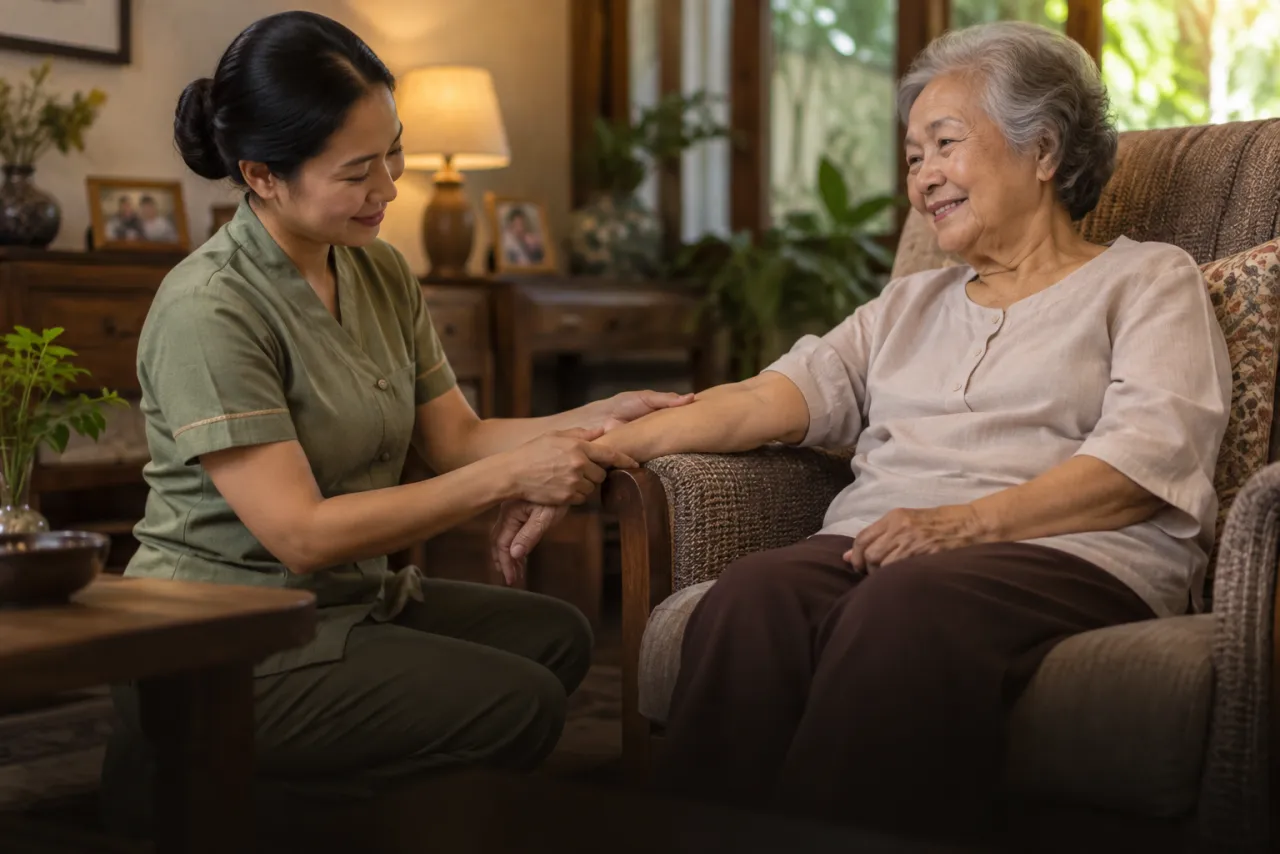
Elderly care massage is home-visit or care-setting work with older clients, usually booked as a repeating weekly appointment rather than a one-off treatment. It differs from ordinary massage mainly in pressure and caution — thinner skin, lower bone density, medications that bruise easily and conditions that rule out certain techniques entirely. The technical skill needed is not exotic, but knowing when not to treat is, which is why demand consistently outruns supply. It also happens to be some of the lightest physical work in the trade.
There is a kind of booking that most therapists never see, because it never reaches a spa reception desk.
A family has a parent in their eighties who no longer walks much. The legs are wasting, the back is stiffening, and the whole household would happily pay for someone to come twice a week. They are not short of money.
They are short of a therapist who knows how to work on an eighty-year-old body.
Why this work keeps growing
Thailand is now an aged society, and so is most of the world that sends tourists here. Families are smaller, adult children work full time, and the person who used to be at home all day looking after a parent no longer exists in most households.
What replaces that is bought in. Massage is high on the list of things families look for, because the effect is visible and it can be done at home without moving anyone.
The supply side has not followed. Almost everyone who trains aims at spas, hotels and tourist shops, which is where the visible jobs are. Very few aim at the client sitting in a wheelchair in a living room in a quiet suburb.
What actually makes it different
This is the part people get wrong. Elderly massage is not a normal treatment performed more gently. The differences are structural.
Bone density is lower. Pressure that is entirely safe on a thirty-year-old ribcage is not safe on an eighty-year-old one.
Skin is thinner and vessels are more fragile. A great many older people take blood thinners. Work too heavily and you leave bruising that takes weeks to clear.
Existing conditions change the rules. Reduced sensation in the feet means a client may not feel that you are pressing too hard — the usual feedback loop is gone. Other conditions rule out certain positions altogether.
Communication is often partial. Some clients cannot tell you clearly where it hurts. You read posture, facial expression and guarding instead, which is a skill you build on real bodies rather than in a classroom.
None of this is exotic technique. It is anatomy plus judgement, which is exactly why watching videos does not get you there. This is the same argument we make about technique generally in what this work does to a therapist's body.
Knowing when to stop
The single most valuable thing you bring to a family is knowing when not to touch someone.
Refer to a doctor before treating if there is fever or suspected infection, an area that is swollen, red and hot, a suspected fracture after a fall, known blood clots or severe varicose veins, open wounds or pressure sores, or recent surgery still healing.
Massage is not a treatment for illness, and nobody should present it as one. What it reasonably offers is relaxation, help with circulation, and relief from stiffness. Anything beyond that belongs to a doctor.
Families who have previously hired someone who did not understand this are the ones who pay well for someone who does. That reputation is the whole business.
The commercial shape of it
Elderly work is usually home visits, and the rate per session is typically higher than shop work because you are travelling and bringing specialist knowledge.
But the real difference from spa work is retention.
In a tourist spa, most clients come once and are never seen again. You are hunting for new bodies every single day. A family that trusts you with their parent books week after week, for months or years, and once trust exists they do not shop around.
Ten regular families is a more stable living than ten walk-ins a day, and it is far less exhausting. We broke down how therapist income is actually structured in what massage therapists earn in Thailand.
The trade-off is honest and worth stating: you carry your own travel, you have no receptionist filling your gaps, and building the first handful of clients is slow. Word of mouth in this niche is powerful but not fast.
It is unusually kind to your body
There is a common assumption that elderly care means lifting and carrying. For the massage side of it, that is not really true.
The pressure required is lighter than a standard treatment, much of the session is worked seated or side-lying, and there is little of the deep sustained loading that wrecks thumbs and wrists.
Foot work has an outsized role here, because it is safe, can be done in a chair, and addresses circulation in people who move very little. For therapists who cannot sustain heavy work — and that includes plenty of people who arrive here in their forties and fifties, as we described in changing careers to massage therapy after 30 — this is one of the few directions in the trade that gets gentler with time rather than harder.
The students who never meant to do this professionally
A recognisable group turns up to train with no career intention at all. They came because their own mother or father is unwell.
What then happens, repeatedly, is that a neighbour or a relative sees them working and asks whether they could help too. Within a year some of them have an accidental practice.
They also tend to be the best students in the room on the safety material, for the obvious reason — the first person they will work on is their own parent.
Where to start
The foundation is the 150-hour Thai massage course, because that is where anatomy, sen lines, contraindications and the full sequence are taught. Everything in elderly work builds on it rather than replacing it.
Foot reflexology, 60 hours, is the natural second piece for this niche and finishes in about 8 days.
| Thai massage, 150 hrs | 4,900 THB · about 19 days |
| Foot reflexology, 60 hrs | 4,900 THB · about 8 days |
| Re-study | free for life |
For therapists who want to specialise further, Michael Thai Massage School also runs a 30-hour Elderly Massage module as continuing training. It is a supplement, not a starting point.
Both courses run at our Bangkok branch beside BTS Si La Salle and at our Pattaya branch in Nong Prue. If you want to talk through whether this direction fits you, or ask about a specific family situation, message us — we will tell you plainly which things massage can help with and which need a doctor first.
Summary
The demand here is not a trend. It comes from population structure, which means it will still be there in twenty years.
The work is light on the body, pays reasonably per hour, keeps clients for years rather than minutes, and most therapists find it means something to them in a way spa work rarely does. What it asks in return is that you take the safety material seriously — because the margin for error with an eighty-year-old client is much smaller than with a tourist.
Frequently asked questions
How is elderly massage different from a normal treatment?
Do I need a specialist course, or is a general one enough?
When should I refuse to treat an older client?
Is this work physically easier than spa work?
Can I use this training back in my own country?
Related courses
- Thai Massage for Health — 150 HoursTuition 4,900 THB
- Foot Reflexology for Health — 60 HoursTuition 4,900 THB
Related searches
Serious about starting? Talk to us first.
Free LINE consultation