Massage Therapist Wrist Pain — How to Avoid It
Sore thumbs, wrists and lower backs are the reason most therapists leave this trade early. Almost all of it comes from mechanics, not from working too much — and mechanics can be fixed.

Short answer
Most pain that massage therapists develop in the thumbs, wrists, shoulders and lower back comes from pressing with muscle instead of transferring body weight through aligned joints. Therapists who learn to stack their body over the point and let weight fall through a straight arm can work several sessions a day for years without accumulating injury. Body mechanics are trainable and are best learned before any technique becomes habit. If you already have night pain, numbness or weakness in the hand, stop and see a doctor before you carry on working.
If you are considering training in Thailand and eventually working with your hands for a living, there is a practical question worth asking before the romantic ones.
Does this job break your body?
The honest answer is that it breaks the bodies of some therapists and not others, and the difference is almost never how much they work. It is how they work.
The single thing that separates long careers from short ones
Are you pressing with your muscles, or with your body weight?
Someone who starts massaging without instruction does what the body suggests first: tighten the hand and push. It works for the first ten minutes. The client says the pressure feels good. But every kilogram of that force travels out through your fingers, wrists and elbows, and nothing else shares the load.
Someone taught properly does something different. They move their own body over the point they are working, then let their weight fall through aligned bone. The arm is a strut, not an engine. It barely works at all.
Over one session the two feel similar to the client. Over three years, one therapist is still taking bookings and the other has a wrist that never quite settles.
This is also, incidentally, one of the things a spa manager watches during a hiring test — we covered that in how to pass a spa trade test.
The four complaints you will hear in every therapist room
Base-of-thumb pain. The most common by a distance. It comes from pressing points with a bent thumb joint, so the joint takes a shearing load instead of a straight one. Correct form keeps the thumb in line with the forearm and sends force straight down the bone.
Pain on the palm side of the wrist. Caused by extending the wrist backwards while leaning on the heel of the hand. The more the wrist is bent, the more the soft tissue at the front is loaded. Keeping the wrist in line with the forearm removes most of it.
Lower back ache. Almost always a distance problem rather than a back problem. The therapist bends toward the client instead of moving their feet closer, and then holds a flexed spine for an hour. Table height and foot position fix more backs than stretching does.
Neck and shoulder tightness. From lifting the shoulders during effort without noticing, usually alongside held breath.
Notice the pattern: every one of these is corrected by changing position, not by building up tolerance. Toughing it out is what turns a habit into an injury.
Why this has to be learned first, not later
Bad mechanics become automatic within a few weeks.
Students who arrive having already massaged informally for a year usually take longer to correct than students who have never touched a client, because their body has already committed to a pattern. Under fatigue or time pressure, everyone reverts to their first habit.
For that reason, weight transfer sits at the start of the 150-hour courses at Michael Thai Massage School — before the sequences, not after them. It is not theory to be memorised. It is the thing that decides how many years you get.
If you are weighing up which foundation course to take first, Thai or oil massage — which to learn first goes through the trade-offs.
Spreading the load across a working day
Experienced therapists rarely take body work back to back for eight hours.
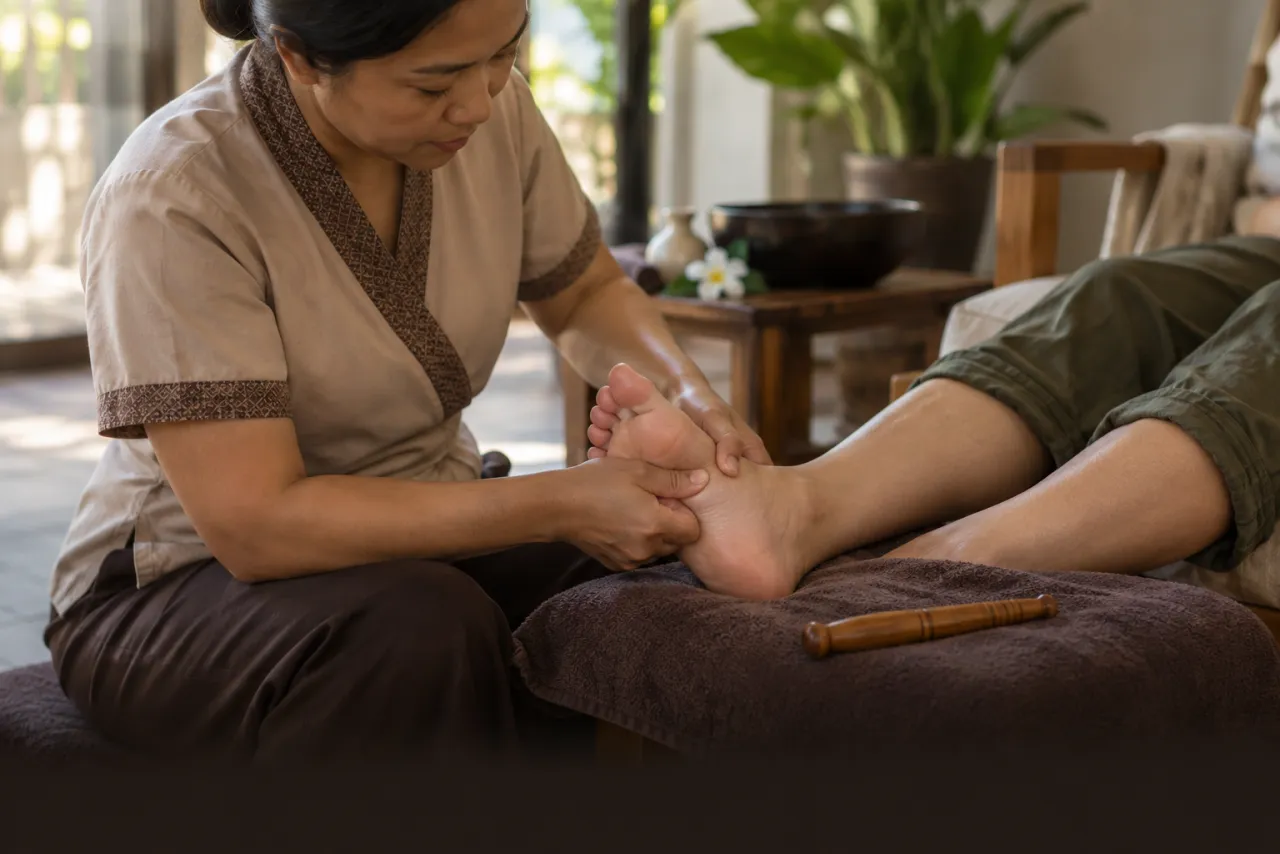
Foot massage is done seated and uses far less compression, so the lower back gets a rest. Face massage works with fingertips and small muscles and barely loads the hands at all.
Mixing three kinds of session across a day means the same tissue is not being asked to do the same thing all day. It usually pays better too, because you can take more bookings without hitting a wall by mid-afternoon. The school runs both of these as 60-hour courses of roughly eight days, which is a realistic add-on either during or after a longer course.
There is a fair criticism to make here: nobody plans their day this neatly when a spa hands them a rota. You will not always get to choose. But knowing which sessions cost you the most is what lets you ask for the right mix when you have any say at all.
What this means if you are training from abroad
Two things worth knowing before you arrive.
First, an intensive course is physically demanding in a way that surprises people. Full days of practice, several days a week, on a body that is not conditioned for it. Expect to be sore in the first week — that part is normal. What is not normal is sharp joint pain, and if it appears you should say so rather than push through quietly to keep up with the group.
Second, mechanics are the part of the training that travels. Sequences differ between countries and between employers. Knowing how to load your own joints correctly does not change wherever you end up working, whether that is here, at home, or on the contract circuit described in working as a massage therapist abroad.
Three things you can check today
1. Table height. Stand upright with your arms hanging loose. The table should sit at roughly wrist height. Higher and you lift your shoulders all session; lower and you bend your back.
2. Move your feet instead of reaching. If you have to stretch your arm to get somewhere, you are standing in the wrong place. One step beats ten reaches.
3. Notice whether you are holding your breath. Therapists working from muscular effort tend to hold breath on the press. If your breathing stays even the whole way through, your weight is doing the work.
Summary
This career does not destroy bodies on its own. Poor mechanics destroy bodies, and good mechanics are not a talent — they are a skill that can be taught in days if the person teaching you treats it as important.
If your hands hurt right now and you are quietly wondering whether to stop, get someone experienced to watch you work before you decide. A lot of therapists who feel finished simply need two or three things corrected.
Want a second opinion, or advice on where to start? Get in touch — asking costs nothing, and you do not have to enrol to ask.
Frequently asked questions
How long can someone realistically work as a massage therapist?
I have wrist pain now. Can I keep working?
I am small and not very strong. Can I do this job?
Are some types of massage easier on the body than others?
I already massage without formal training. Is it too late to fix my technique?
Related courses
- Thai Massage for Health — 150 HoursTuition 4,900 THB
- Aromatherapy Oil Massage for Health — 150 HoursTuition 4,900 THB
- Foot Reflexology for Health — 60 HoursTuition 4,900 THB
Related searches
Serious about starting? Talk to us first.
Free LINE consultation